
Every year, thousands of Mumbai residents have heart attacks. Many had “normal” cholesterol. Many had “no symptoms.” Many were shocked.
They shouldn’t have been, because the warning was there all along — in a test called hsCRP.
What is hsCRP?
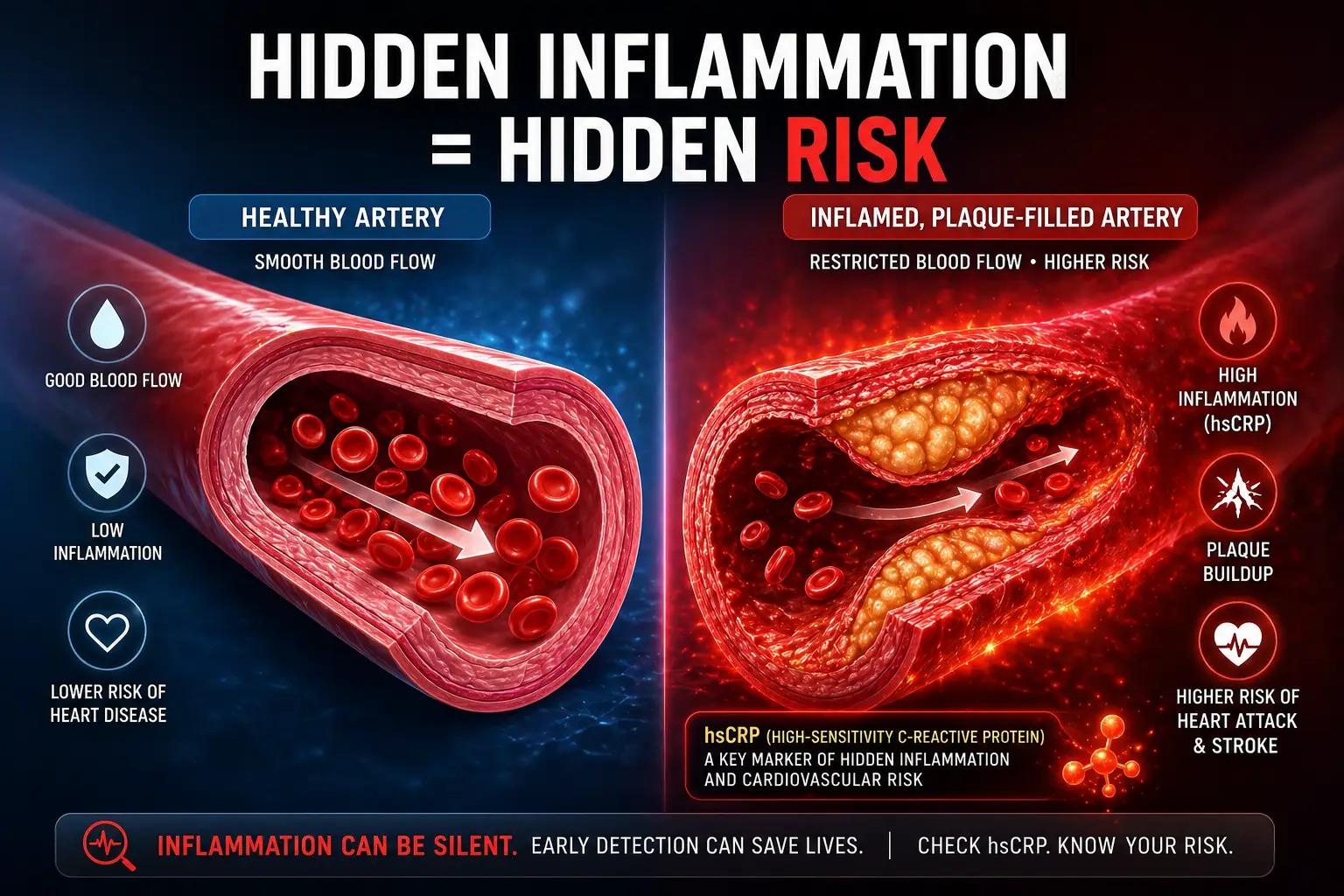
hsCRP stands for High-Sensitivity C-Reactive Protein. CRP is a protein produced by the liver in response to inflammation. The high-sensitivity version of the test can detect very low levels of inflammation — levels that standard CRP tests miss entirely.
Why does this matter? Because inflammation, not just cholesterol, is now understood to be a primary driver of cardiovascular disease.
When blood vessel walls are chronically inflamed, plaque builds up faster. Blood clots form more easily. The risk of a heart attack multiplies dramatically.
What the Research Says
The landmark JUPITER trial — published in the New England Journal of Medicine in 2008 — studied nearly 18,000 people with normal LDL cholesterol but elevated hsCRP. Those with high hsCRP had significantly higher rates of heart attack and stroke.
More importantly, treating elevated hsCRP substantially reduced cardiovascular events — even when cholesterol was not the problem.
In India, a 2019 study in the Indian Heart Journal found elevated hsCRP in over 40% of apparently healthy urban individuals in cities like Mumbai and Delhi. Chronic inflammation from stress, poor diet, pollution, and disrupted sleep is rampant.
hsCRP vs. Regular CRP: What’s the Difference?
Standard CRP measures acute inflammation — infections, injuries, post-surgical states. It’s useful in ICUs and emergency rooms.
hsCRP measures chronic, low-grade inflammation — the smouldering kind that damages arteries over the years. It’s a completely different clinical use.
Normal hsCRP for cardiovascular risk:
- Below 1.0 mg/L → Low risk
- 1.0 to 3.0 mg/L → Moderate risk
- Above 3.0 mg/L → High risk (evaluate carefully)
- Above 10 mg/L → May indicate acute infection — repeat in 2 weeks
Who Should Get This Test?
- Anyone with a family history of heart disease
- Smokers and ex-smokers
- Overweight or obese individuals (visceral fat is a major source of inflammation)
- People with autoimmune conditions like rheumatoid arthritis
- Mumbai’s corporate workforce — chronic work stress directly elevates CRP
- Anyone over 40 doing a cardiac risk assessment
hsCRP is an essential part of a complete cardiac risk panel. Yet most routine blood tests don’t include it.
Aspira Diagnostics offers hsCRP as part of its advanced Cardiac Profiles and the Aspira Imperia executive health package (₹10,500). It can also be ordered as a standalone test.
Inflammation is silent. hsCRP is its voice. Listen before your heart has to shout.
📞 Book your hsCRP test at Aspira Diagnostics — Call 72080 42200 or visit any of our 20+ centres across Mumbai.